


Murder at Enscombe Park
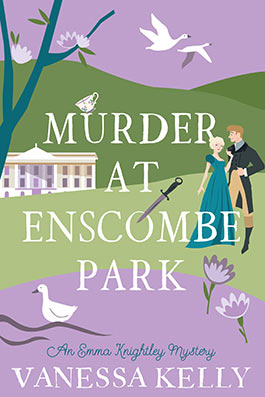
The Emma Knightley Mysteries, Book 3
Kensington Books
November 2026
ISBN: 978-1496746030

When Jane Austen’s Regency-era heroine Emma Knightley visits her pregnant friend Jane and her husband Frank Churchill at their Yorkshire estate, a proper country house party soon becomes the site of a ghastly murder . . .
Emma, her husband George, and her father and his new wife have journeyed to Enscombe Park, the grand estate where Jane and Frank live with his uncle, who adopted Frank as a boy. Upon their arrival, they are concerned to find Jane wan from her condition, Frank bruised from a mysterious accident, and Mr. Churchill in an ill temper, as well as surprised by additional houseguests including Miss Caroline Bingley and a distant cousin from the West Indies.
Emma worries this might all be too much for Jane, but it is Mr. Churchill who is decidedly out-of-sorts, possibly due to his heart medication. When Frank’s uncle is found dead in the library, it appears he’s fallen victim to heart seizure. But Emma—despite George’s admonitions to stay out of it—begins to wonder if he may have been poisoned.
Experience has taught Emma that her matchmaking instincts may not always be spot-on, but her sleuthing skills are as sharp as ever. As a recently altered will and secret debts come to light, suspicion falls on Frank Churchill of all people. Now it’s up to Emma to save her friend’s husband from the gallows . . .
Chapter 1
Yorkshire
Late spring, 1817
Emma Knightley dearly loved her father, but today tested her patience.
“I knew this trip would be disastrous,” Father dramatically announced. “I shouldn’t wonder if we all expire from a contagion.”
For an elderly man who hated travel, a three-day trip to Yorkshire would seem daunting. Accordingly, Emma had carefully planned the journey. They’d travelled in their comfortable carriage attended by their own staff, and stayed at the best coaching inns.
Unfortunately, she’d failed to anticipate one critical element.
Damp sheets.
“I shudder to think of the outcome if not for your stepmother’s quick thinking,” Father added. “To sleep on damp sheets could be fatal to one’s health.”
Hetty, seated next to her husband, patted his knee. “It was a simple matter of airing out the sheets, dear sir. They were dry in a trice.”
“Thank goodness for you, ma’am. You managed the situation so well,” Emma said, winking at her stepmother.
Emma still found it astonishing that Miss Henrietta Bates was now Mrs. Henry Woodhouse—her father’s wife and her stepmother. Hetty had become quite adept at managing her husband, as their near fatal encounter with damp sheets had illustrated.
“I thought the inn’s food was surprisingly good,” said George. “The beef in particular was excellent.”
Father huffed. “There was too much cake.”
To Emma’s father, cakes were the equivalent of poison.
A moment later, the carriage bounced through a bumpy patch of road. Emma’s stomach pitched sideways. It was odd. She never felt queasy, even when facing backward in a carriage. Of course, she had eaten quite a lot of cake last night, or perhaps it was . . . something else.
No need to mention what that something else might be, including to her husband. It was too early to be sure of anything.
Her father peered at her with sudden anxiety. “My dear child, are you feeling unwell?”
Emma shook her head. “My stomach was simply surprised by that bounce. It took a moment to catch up.”
“I cannot say I’m surprised that your stomach is bothering you,” he said. “You had cake last night, against my express advice.”
“I think I’m just tired of being cooped up in this carriage,” she replied.
“Perhaps you can have a nice bowl of gruel when we arrive at Enscombe,” her father said in an encouraging tone. “Surely the Churchills’ cook knows how to make a nice gruel.”
If anything could make Emma cast up her crumpets, it would be gruel. It had been the bane of her childhood, but to her father it constituted a universal cure.
“I’m fine, I promise,” she replied. “Besides, look how well we’ve weathered our journey. We’ve been travelling for over three days and not one of us has fallen ill.”
Father reacted with alarm. “You mustn’t tempt fate, Emma. Remember the sheets!”
“We’ll be off the road very soon, dear.” Emma glanced out the window. “In fact, we should be arriving at Enscombe’s gates momentarily, since we just passed the turnoff to Haxby. Frank wrote that Enscombe is less than two miles from that point.”
Hetty’s pale blue eyes shone from behind her spectacles. “I cannot believe we’re finally going to see Jane and Frank! I’ve been so worried about dearest Jane. Her health is never quite as good as it should be, you know. And now that she is in the family way again, she does suffer more than usual. I’m determined to do everything I can to help her.”
“Jane assured me in her last letter that she was feeling more settled,” Emma replied. “And you mustn’t forget that you and Father are on your bridal trip. Jane would certainly wish you to enjoy yourself.”
Hetty turned pink, looking as shy as a bride in the first flush of youth. “Dear Mr. Woodhouse and I cannot be considered newlyweds, at this point. I can hardly believe it, but it’s been over a year since we first took our vows.”
Emma’s father smiled. “What a cherished day that was, my dear—although I cannot approve of bridal trips in general. It’s much better to remain at home, where one can be perfectly quiet and cozy.”
It had taken both Emma and Hetty several weeks to convince Emma’s father to make the trip from Surrey to the Yorkshire estate that was home to Frank and Jane Churchill. The former Jane Fairfax was Hetty’s beloved niece, while Frank was the son of Mr. Weston, an old friend of the Woodhouse family. Frank, however, had not been raised by his father but rather by his Churchill relations. He’d taken their surname and was now the designated heir to the Churchill fortune and Enscombe Park, their estate.
It was to be an intimate family gathering, quiet and peaceful. And since Enscombe Park was considered one of the finest estates in all of Yorkshire, Emma was anticipating an enjoyable visit with their friends.
George peered out the carriage window. “I believe I see the gates to Enscombe Park ahead.”
For some minutes their coach’s path had paralleled a brick wall, which Emma now realized marked the perimeter of Enscombe’s lands. As the carriage passed between the scrolled, wrought iron gates, she could begin to get a true sense of the impressive size of the park. Soon, they were bowling along a wide avenue set between majestic oaks.
“Can you see the house yet, Father?” Emma asked.
“All I can see are trees. We seem to be in the middle of a forest, my dear. I do hope our coachman doesn’t get lost.”
“I’m sure he won’t, dear. This is the main road to the house.”
“Apparently, Enscombe has one of the finest stands of timber in Yorkshire,” Hetty commented. “Jane tells me that some of the oaks and holly trees are hundreds of years old. But I think the woods are coming to an end. Look—Enscombe! The roof, anyway, above the trees.”
“More trees,” sighed her father.
Emma lifted her eyebrows. “I thought you liked trees, Father.”
“Everything in moderation, my dear. Trees shelter all sorts of vermin—not to mention poachers. I shouldn’t be at all surprised if Mr. Churchill has a problem with poachers.”
“I’m sure there are no poachers at Enscombe, dear.”
“If you say so,” he replied in a tone suggesting the opposite.
“We’re here,” George announced as the carriage began to slow.
Thank goodness.
They were now passing through expansive ornamental gardens that fronted the house. Graveled walks were lined with neatly trimmed hedges, while flowering shrubs and white cherry trees ringed the perimeter. It was a lovely frame for the striking house that now presented itself as the carriage turned into a paved courtyard.
Hetty clapped her hands together, her eyes wide behind her gold spectacles. “Heavens! Jane’s letters do not do Enscombe justice.”
“I recall Frank commenting that his late aunt found the house too cold,” Father darkly said. “One can understand the sentiment, since corridors are often drafty in these excessively large houses. No wonder the poor lady died in so sudden and untimely a manner.”
Of all the details to remember about Enscombe, it would have to be that one.
The carriage door opened and Simon, their head footman, held out a hand to assist them. Emma followed Hetty down to the pavement, where she briskly shook out her skirts.
“I’m sure I look a mess,” she said as her husband joined her.
“You look fine,” George absently replied as he stared up at the building in front of them.
She couldn’t blame his inattention. Enscombe was one of the largest houses in Yorkshire, with a towering center block in red brick, topped by a handsome pediment. Built in the Palladian style, the central portion of the house was framed by two large wings, mirroring each other with pleasing symmetry. A large glass conservatory was attached to the end of one wing, with a terrace that led down to a little glade of daffodils and tulips.
Turning around, Emma took in the view from the front of the house. Paved flagstones ran up to the edge of the manicured lawn, with its surrounding flower gardens. Through the middle of it, a path ran down to more lawns. A stone fountain stood off in the distance and intriguing pathways meandered toward the home wood. It was a delightful prospect she couldn’t wait to explore.
“Dear me, that is a very large garden,” said her father.
Emma bit back a smile. Even Father, ever devoted to his beloved Hartfield, sounded reluctantly impressed.
“Ah, here’s Jane and Frank,” said George.
Emma turned to see her friends coming through the front door. Jane practically flew down the short flight of stairs.
“I thought you would never arrive,” she exclaimed as she threw herself into her aunt’s arms.
“Oh, my dearest,” said Hetty, returning her embrace. “You do look pale, but better than I expected.”
“And all the better for having her favorite people here for a visit,” said Frank as he joined them. “She’s been counting the hours until your arrival.”
Emma blinked at the sight of him. “Goodness, Frank! You look like you’ve gone ten rounds in the boxing ring. Whatever is the matter?”
Their friend, normally the picture of health, was sporting a yellowing bruise along one side of his face. His left wrist was wrapped in sturdy bandage, and his movements were stiff, lacking their usual grace.
“Just a stupid fall off my horse.”
Jane grimaced. “Actually, it was a very bad accident, and you were lucky to escape with only those injuries.”
“I’m sorry to hear that,” George said. “No lasting damage, I hope?”
“Not in the least.” Frank extended his good hand to George. “Nothing broken, just some bruises and a sprained wrist. Thankfully, my horse escaped injury, for which I’m most grateful.”
Emma’s father was instantly on the alert. “Bruises can be very deleterious, Frank. I feel certain I have some remedies in my trunk that will prove helpful in healing them.”
Chuckling, Frank put up a hand. “We have an excellent surgeon in the village, Mr. Woodhouse. Of course, he’s no Mr. Perry, but we’re very lucky to have such an experienced practitioner nearby.”
Mr. Perry, Highbury’s apothecary, was the Woodhouse family’s most trusted medical confidant.
“Indeed, there is no one quite like our dear Perry,” Father solemnly declared. “What a shame he could not make the trip with us.”
Emma’s father had actually invited Mr. Perry along on the trip. Fortunately, Mrs. Perry had put her foot down.
“Seeing you is all the remedy we need,” Frank replied. “Come along, everyone. Into the house.”
Emma took Jane’s arm, following Hetty and the others toward the stairs.
“How are you, Jane? Really?” Emma asked in a low voice.
Her friend mustered a smile. Despite the fact that she was clearly happy to see them, Jane looked pale and drawn.
Worried.
“I admit to feeling a trifle unwell,” Jane replied. “But it was much the same when I was in the family way with Clarissa. Our surgeon—Mr. Ashe, who is very good—assures me that everything is well.”
“Still, you must be sure to let Hetty and me help you in any way we can.”
“I cannot tell you what a comfort it is to have you both here.”
“But something else is bothering you, isn’t it?” asked Emma as they started to climb the front steps.
Jane blew out an exasperated breath. “Frank’s accident. It was truly a terrible fall, Emma—not that he’ll admit it. He becomes quite cross when I try to talk to him about it.”
That seemed odd. “Is there something specific about the accident that bothers you?”
Frank waited for them in the doorway. “What are you two whispering about like little conspirators?”
His jovial tone didn’t match the sharpness of his gaze.
“I was just telling Emma about the arrangements for Mr. Woodhouse and Aunt Hetty,” Jane brightly replied.
And that was a blatant lie. Clearly, something had Jane in a stew. Emma would have to get the young woman alone before she could find out what it was.
Frank nodded at the liveried footman holding the door and ushered their party inside.
The long entryway was divided from the main hall by a set of columns topped with elaborate plasterwork. A magnificent Japanese chest stood against one wall, covered with a collection of Chinese pottery. An elaborate, marble-topped table in the rococo style stood opposite, and next to that was an impressive, longcase clock, obviously a Chippendale.
They had yet to even reach the main hall, and Emma was already struck by the lavish elegance on display.
Frank flashed her a wry smile. “I hope you are properly impressed by Enscombe’s beauties.”
“I am,” she truthfully replied. “I can’t wait to see the rest of the house.”
“Feel free to compliment my uncle’s good taste as much as you like. Architecture and design have always been passions of his, and my aunt had a great fondness for landscape design. Between the two of them, they were constantly improving on the house and grounds.”
Emma was about to reply when she became aware of a disturbance among the arrivals. The source was her father, whose manner indicated agitation. When Hetty cast her an imploring glance, Emma hurried into the main hall.
“Is everything all right, Father?” she asked.
He flapped a hand. “This was to be a small family gathering, Emma. Yet now I hear that the house is crawling with other guests!”
Frank joined them. “I see Jane has been telling you about our surprise visitors.”
“She has, indeed,” George dryly replied.
Jane grimaced. “I do apologize, Emma. One of our guests is family, and he’s been staying with us for some weeks. But the others were completely unexpected. I had no idea my uncle had even invited the Braithwaites until they showed up on our doorstep a few days ago.”
“I rather think they invited themselves,” Frank said, lowering his voice. “Still, we couldn’t put them off. Their visits are sacrosanct at Enscombe.”
“They’re old friends of the Churchills, I believe?” commented Emma.
Frank nodded. “They generally come in January, but Mr. Braithwaite was ill at the time. Since they had already planned a trip south to see family in London this spring, Mrs. Braithwaite thought it made sense to visit Enscombe on the way. But they’ll be no trouble at all, I promise.”
“Yes, they’re very good and kind,” added Jane.
“But there are others,” Emma’s father plaintively said. “And who knows what infectious complaints they might be bringing into the house?”
“Dear sir,” Hetty earnestly said. “Frank would never allow infectious people into the house.”
“True enough. I’m the only invalid in the bunch,” Frank humorously responded.
“Who are these other guests?” asked George.
“Also old friends of the family,” Jane replied in an apologetic tone. “At least Mr. Hurst is. His party’s visit was something of a scramble, as they only gave us two-days’ notice. But the Churchills and Hursts have known each other forever. Frank’s uncle went to Cambridge with Mr. Hurst’s father.”
“How many are in Mr. Hurst’s party?” Emma asked.
“Only three,” Frank replied. “His wife, Louisa, and her sister, Miss Caroline Bingley. So you see, it’s not such a big group after all.”
“And then there’s Reggie . . . Mr. Reginald Boland,” said Jane, correcting herself. “But, as I said, he’s family.”
Frank rolled his eyes. “Of a sorts. Don’t know when we’re going to get rid of the fellow.”
“Really, dearest,” Jane gently scolded. “You shouldn’t say such things about poor Reggie.”
Her husband looked unrepentant. It would seem there was quite a lot going on at Enscombe Park, and not all of it good.
“I do think you’ll enjoy meeting Mrs. Hurst and Miss Bingley, though,” Jane said to Emma. “They’re very elegant ladies.”
“Indeed,” said Frank, recovering his good humor. “And now that you’ve arrived, it’s a proper jolly house party.”
Emma flicked a glance around her own family. George looked irritated, Hetty was obviously torn between wanting to please her niece and worrying about her husband, and Father appeared ready to launch into one of his nervous spells.
“Whatever are we to do, Emma?” her father fretfully asked.
“Go to our rooms, get settled, and have a nice cup of tea.”
Or, in her father’s case, a hefty dose of calming powders. As for George, a brandy might be welcome.
As she and Jane shepherded their little group of malcontents upstairs, Emma found that she didn’t share her family’s irritation. She’d never been to a proper house party before. They never had visitors at Hartfield other than her sister’s family, and George was almost as allergic to large gatherings as her father. In the privacy of her own thoughts, Emma had occasionally lamented the antisocial nature of the males in her family.
Their visit to Enscombe was shaping up to be more interesting than she’d initially assumed it would be. And that was a refreshing prospect, indeed.


